
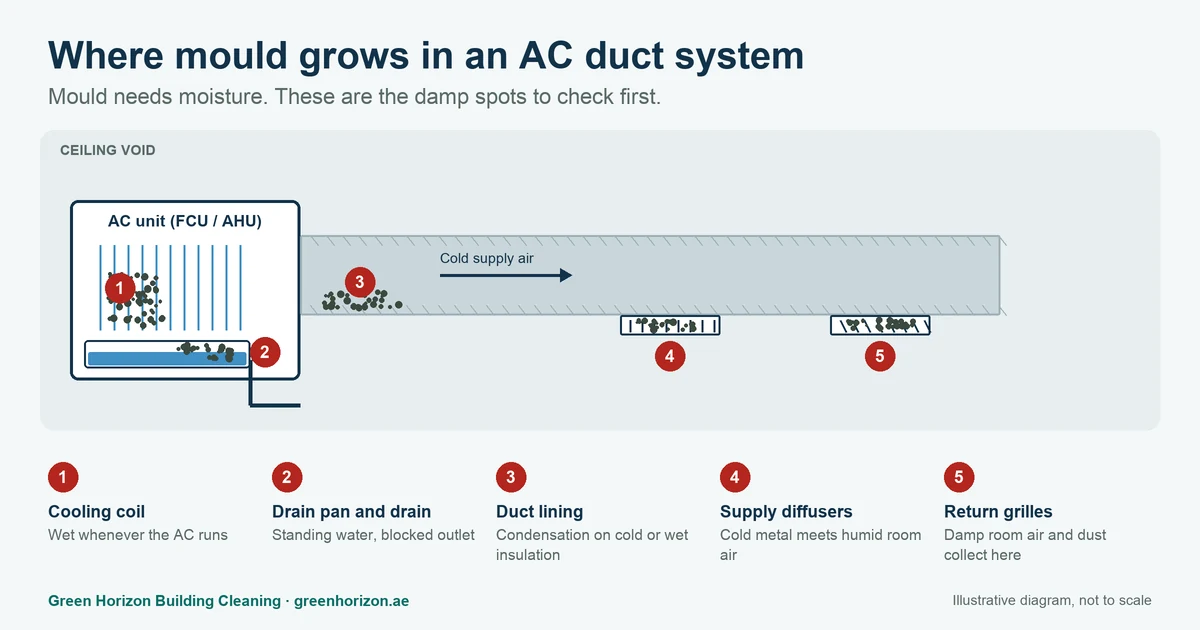
A musty smell when the AC starts, or dark specks around a vent, makes most people in the UAE assume the worst. Sometimes it is mould. Often it is just dust. This guide explains how to tell the difference, why mould (or "mold", depending on where you learned your spelling) grows inside AC systems here, and what actually gets rid of it for good.
The short version: mould needs moisture. If the moisture problem isn't fixed, cleaning alone only buys you a few months.
Why AC systems in the UAE grow mould
Mould needs three things: spores, something to feed on, and moisture. Spores are everywhere, and the dust that collects inside ducts gives them plenty to feed on. So moisture is the part that decides whether mould grows or not.
The UAE supplies plenty of it. Coastal cities like Dubai, Abu Dhabi and Sharjah have long stretches of high humidity, and an AC removes that water from the air by condensing it on a cold coil. Several local conditions then make things worse:
- Cold surfaces next to humid air. Where a cold duct or diffuser meets warm, damp air, water condenses on the metal. It is the same effect as a cold glass sweating on a summer terrace.
- Blocked condensate drains. Dust and slime can block the drain, so water sits in the pan instead of leaving the unit.
- Empty properties in summer. An apartment or villa left closed with the AC switched off can become hot and damp very quickly. Many people find the problem when they return from a long trip.
- Leaks and past water damage. A leaking pipe in the ceiling void or a past flood can leave duct insulation wet long after the visible damage has been repaired.
Where to look
Mould rarely spreads evenly through a duct network. It starts in the damp spots shown in the diagram above: the cooling coil, the drain pan, duct lining that has been wet, and the diffusers and return grilles. You can check the grilles yourself. Checking the coil, pan and duct interior usually means opening the unit, which is a job for a technician.
Signs of mould in AC ducts
None of these signs proves there is mould, but two or more together are worth an inspection:
- A musty, earthy smell that appears when the AC starts and fades when it is off
- Dark spots on or around diffusers that return soon after being wiped
- Water marks or staining on the ceiling near a vent or the AC unit
- Water dripping from the unit, or a drain that has overflowed before
- Stuffiness or allergy symptoms that ease when you leave the building
If anyone in the building has asthma, a mould allergy or a weakened immune system and symptoms are getting worse, speak to a doctor as well as arranging an inspection.
Is it mould or just dust?
You often can't tell by looking. Grey fluff that wipes away cleanly and comes back slowly is usually dust. Black specks that smear, sit around a damp area or return within days are more suspicious. Even then, dark marks can be dust stuck to condensation, or a stain.
The US Environmental Protection Agency's guidance on air duct cleaning makes the same point: not everything that looks like mould is mould. If the answer affects a big decision, such as replacing ductwork or settling a dispute with a landlord, ask for a sample to be tested by a laboratory.
What actually fixes it
Doing these steps in order matters. Cleaning first and looking for the water later is the most common reason mould comes back.
- Find the moisture source. Check for a blocked drain, a leak, poorly insulated duct or an oversized unit that cools the room without removing enough humidity.
- Fix it. Clear the drain, repair the leak or correct the insulation. The EPA is clear that mould will come back if the conditions that caused it aren't corrected.
- Replace wet insulation. Mouldy or wet porous insulation can't be cleaned effectively, according to the same EPA guidance, and should be removed and replaced. Be careful of anyone who says they can clean it.
- Clean the hard surfaces. Sheet-metal ducts, coils, pans and grilles can be cleaned. Brushing and vacuum extraction under negative pressure capture the loosened material so it isn't blown into the rooms.
- Disinfect where it is appropriate. Disinfectant is a final step after physical cleaning and can't replace it. Ask which product will be used and whether it suits your duct material.
- Keep it dry. Maintain the drain and keep indoor humidity under control, including while the property is empty.
What not to do
- Don't spray bleach or air freshener into the vents. It won't reach the source, and the fumes go straight into the air you breathe.
- Don't just paint over stained grilles or ceilings. The stain disappears for a while, but the damp stays.
- Don't assume a routine AC service covers it. A service looks after the machine and usually doesn't include the ducts. Our guide to AC duct cleaning vs AC servicing explains the difference.
How to prevent it coming back
- Have the condensate drain and pan checked at every AC service.
- Replace or wash filters on schedule, since less dust means less for mould to feed on.
- When leaving a property for weeks, ask a technician what AC or humidity setting suits your unit rather than switching everything off.
- Deal with leaks quickly and check the ceiling void around the unit afterwards.
- Keep to a sensible inspection schedule. Our article on how often to clean air ducts covers the typical intervals.
Common questions
Can mould in AC ducts make you ill?
Mould can trigger allergy and asthma symptoms in sensitive people, and damp indoor spaces are linked to breathing problems. It doesn't affect everyone in the same way, and a musty smell alone doesn't tell you the level of risk. If you have symptoms, see a doctor.
How much does mould cleaning in AC ducts cost?
It depends on the size of the network, how far the mould has spread and whether insulation needs replacing, so a fair price usually follows an inspection. Our AC duct cleaning cost guide explains what affects the price.
Will cleaning the ducts remove the smell?
It will if the smell comes from contamination inside the ducts, and only for a while if there is still a moisture problem. A smell that returns within weeks usually means the water source hasn't been found.
Can I clean mould from the vents myself?
You can wipe a removable grille with mild detergent and dry it fully. That only treats what you can see. Mould that keeps coming back, or that you can't reach, needs an inspection.
What about mould after a flood or major leak?
Water damage changes the job, because wet insulation and building materials may need removing. See our post-flood decontamination service for how that work is handled.
When to call a professional
Call someone if the smell or spots keep returning, the unit has leaked, or anyone's symptoms are getting worse. Green Horizon has worked on AC systems in UAE homes and commercial buildings since 2007. Our AC duct cleaning service starts with a free survey, and we'll tell you honestly if the real problem is a drain or a leak that cleaning won't solve.